Showing posts with label all. Show all posts

Monday, October 07, 2024

Онова, без което не можеш и кеото е по-дълбоко от любовта, е невинността. Невинността е източникът на любовта.
by (https://webstage.bg/roditelstvo/2823-kogato-detsata-se-chuvstvat-malki-i-slabi-napomnyayte-im-che-sa-detsa-na-vselenata-diypak-chopra.html)

Wednesday, June 07, 2023

Translated by Borges himself, Bloy writes

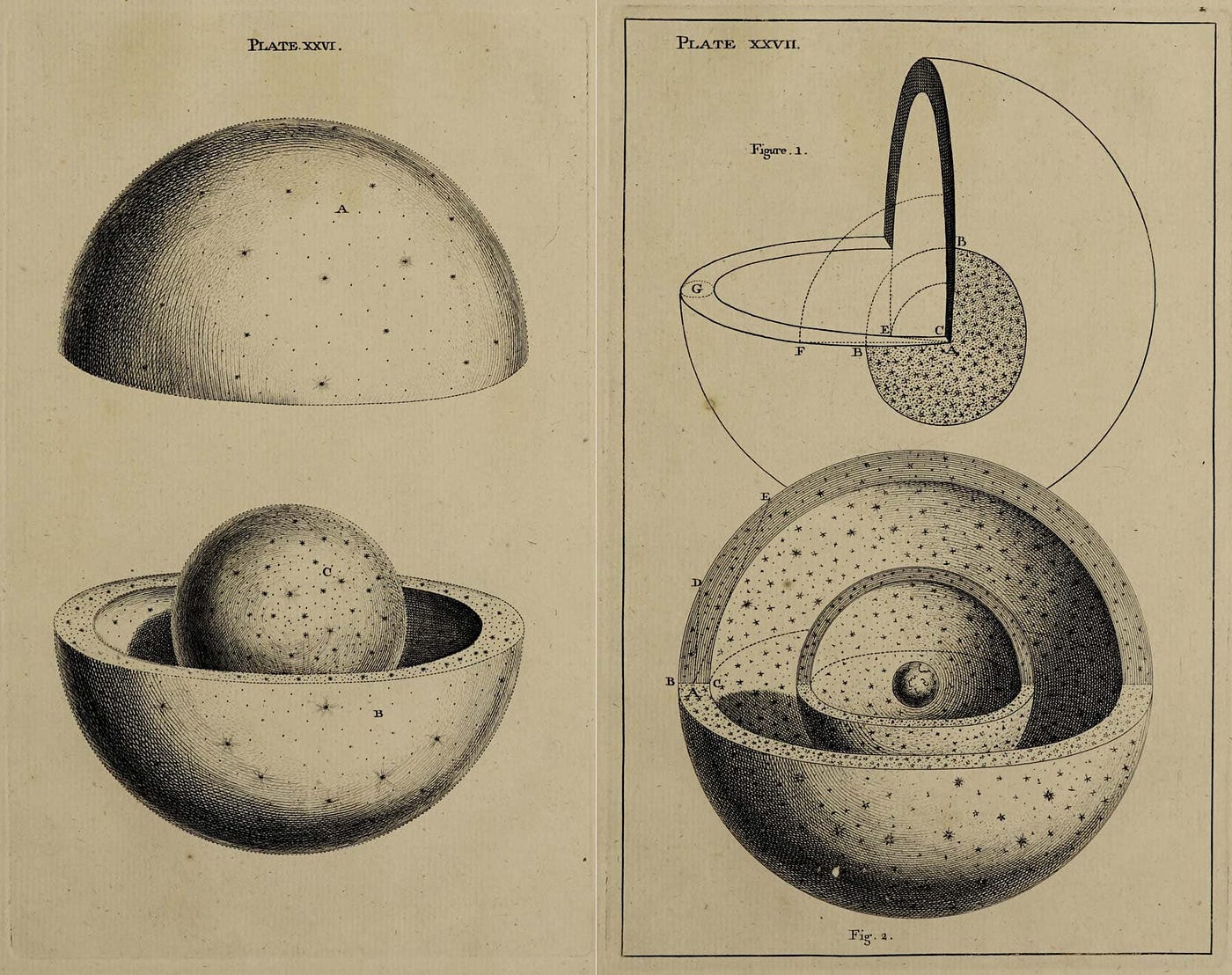
[St. Paul’s famous cryptic statement Videmus nunc per speculum in aenigmate] would be a skylight through which one might submerge himself in the true Abyss, which is the soul of man. The terrifying immensity of the firmament’s abyss is an illusion, an external reflection of our own abysses, perceived “in a mirror.” We should invert our eyes and practice a sublime astronomy in the infinitude of our heart… If we see the Milky Way, it is because it actually exists in our souls.
by (https://www.themarginalian.org/2021/06/10/the-mirror-of-enigmas-borges-bloy and https://www.themarginalian.org/2021/02/16/thomas-wright-original-theory/)

Monday, October 31, 2022

On Children by Khalil Gibran

And a woman who held a babe against her bosom said "Speak to us of children" Your children are not your children They are the sons and daughters of life's longing for itself They come through you but not from you And though they are with you yet they belong not to you You may give them your love but not your thoughts For they have their own thoughts You may house their bodies but not their souls For their souls dwell in the house of tomorrow Which you cannot visit, not even in your dreams You may strive to be like them But seek not to make them like you For life goes not backward, nor tarries with yesterday You are the bows from which your children As living arrows are sent forth The archer sees the mark upon the path of the infinite And he bends you with his might That his arrows may go swift and far Let your bending in the archer's hand be for gladness For even as he loves the arrow that flies So he loves also the bow that is stable..

Wednesday, November 24, 2021

The Geometry Of Grief

“The distance between here and there is the answer to the wrong question.”
... is also the way to view and live through grief — an exercise in continual dilation of perspective, so that life can be seen from more and more angles besides the acuteness of loss, noticing more and more of what is there, what remains and what grows in the wake of the lost; an exercise in remembering, again and again, that healing is subtle and unpredictable, unfolding in tiny, quiet, immeasurable increments that eventually add up to profound changes of measurable difference.
Small changes may not cause large differences, but small changes, invisible because of our inability to measure exactly, can mask our ability to predict whether, when, and where large differences can occur. Chaos is about the breakdown of our ability to forecast for more than a short time.
by (https://www.themarginalian.org/2021/11/10/geometry-of-grief-michael-frame/)

Sunday, September 26, 2021

How to be anxious by David Egan

Kierkegaard, Sartre and Heidegger all think we have a strong motive to flee anxiety when it strikes us. Our freedom entails a heavy burden of individual responsibility, which is daunting. Much easier, then, to act as if the big questions of how to live and how to make sense of things were already settled.
by (https://psyche.co/guides/how-to-be-anxious-like-kierkegaard-sartre-and-heidegger)

Monday, June 21, 2021

Kierkegaard on our greatest source of unhappiness — and its antidote

The unhappy person is one who has his ideal, the content of his life, the fullness of his consciousness, the essence of his being, in some manner outside of himself. The unhappy man is always absent from himself, never present to himself. But one can be absent, obviously, either in the past or in the future. This adequately circumscribes the entire territory of the unhappy consciousness.
by (https://www.brainpickings.org/2014/05/05/kierkegaard-on-presence-unhappiness)

Wednesday, April 07, 2021

Hannah Arendt on Love

Fearlessness is what love seeks... Such fearlessness exists only in the complete calm that can no longer be shaken by events expected of the future…
by (https://www.brainpickings.org/2019/02/25/love-and-saint-augustine-hannah-arendt/) Illustration by Maurice Sendak from I’ll Be You and You Be Me by Ruth Krauss.
Also https://aeon.co/videos/whats-essential-is-i-must-understand-a-rare-candid-interview-with-hannah-arendt

Alan Watts on Freedom

The meaning of freedom can never be grasped by the divided mind. If I feel separate from my experience, and from the world, freedom will seem to be the extent to which I can push the world around, and fate the extent to which the world pushes me around. But to the whole mind there is no contrast of “I” and the world. There is just one process acting, and it does everything that happens. It raises my little finger and it creates earthquakes. Or, if you want to put it that way, I raise my little finger and also make earthquakes. No one fates and no one is being fated.
by (https://www.brainpickings.org/2021/03/16/alan-watts-freedom-fear-love/) Art by Thomas Wright from his Original Theory or New Hypothesis of the Universe, 1750.

Tuesday, February 16, 2021

The Spell of the Sensuous by David Abram

Magic… in its perhaps most primordial sense, is the experience of existing in a world made up of multiple intelligences, the intuition that every form one perceives — from the swallow swooping overhead to the fly on a blade of grass, and indeed the blade of grass itself — is an experiencing form, an entity with its own predilections and sensations, albeit sensations that are very different from our own.
by (https://www.brainpickings.org/2019/07/07/the-spell-of-the-sensuous-david-abram/)

Tuesday, February 09, 2021

Song: “Blue Moon” by Snowblink
Mad Girl’s Love Song

I shut my eyes and all the world drops dead;
I lift my lids and all is born again.
(I think I made you up inside my head.)

The stars go waltzing out in blue and red,
And arbitrary blackness gallops in:
I shut my eyes and all the world drops dead.

I dreamed that you bewitched me into bed
And sung me moon-struck, kissed me quite insane.
(I think I made you up inside my head.)

God topples from the sky, hell’s fires fade:
Exit seraphim and Satan’s men:
I shut my eyes and all the world drops dead.

I fancied you’d return the way you said,
But I grow old and I forget your name.
(I think I made you up inside my head.)

I should have loved a thunderbird instead;
At least when spring comes they roar back again.
I shut my eyes and all the world drops dead.
(I think I made you up inside my head.)
by Sylvia Plath in The Bell Jar

by (https://literaryjukebox.brainpickings.org/post/30583159689)
by (https://www.brainpickings.org/2021/01/31/elizabeth-bishop-one-art/)

Friday, February 05, 2021

Simone Weil on Attention and Grace

We have to try to cure our faults by attention and not by will.

The will only controls a few movements of a few muscles, and these movements are associated with the idea of the change of position of nearby objects. I can will to put my hand flat on the table. If inner purity, inspiration or truth of thought were necessarily associated with attitudes of this kind, they might be the object of will. As this is not the case, we can only beg for them… Or should we cease to desire them? What could be worse? Inner supplication is the only reasonable way, for it avoids stiffening muscles which have nothing to do with the matter. What could be more stupid than to tighten up our muscles and set our jaws about virtue, or poetry, or the solution of a problem. Attention is something quite different.

Pride is a tightening up of this kind. There is a lack of grace (we can give the word its double meaning here) in the proud man. It is the result of a mistake.

by (https://www.brainpickings.org/2015/08/19/simone-weil-attention-gravity-and-grace/)
Wednesday, January 06, 2021

Kierkegaard on Boredom

In a section of his 1843 masterwork Either/Or: A Fragment of Life, which also gave us Kierkegaard on our greatest source of unhappiness, the Danish philosopher defines boredom as a sense of emptiness and examines it not as an absence of stimulation but as an absence of meaning — an idea that also explains why it’s possible, today more than ever, to be overstimulated but existentially bored.
by (https://www.brainpickings.org/2015/01/14/kierkegaard-boredom-idleness-either-or/)
Illustration by Edward Gorey from ‘The Shrinking of Treehorn’ by Florence Parry Heide.

Saturday, January 02, 2021

Too-ticky’s Guide to Life from Tove Jansson

Too-ticky offers comforting solidarity in Moomintroll’s lament that he doesn’t understand the snow: I don’t either… You believe it’s cold, but if you build yourself a snowhouse it’s warm. You think it’s white, but at times it looks pink, and another time it’s blue. It can be softer than anything, and then again harder than stone. Nothing is certain.
by (https://www.brainpickings.org/2014/09/29/too-ticky-quotes-tove-jansson/)

Thursday, December 31, 2020

Monday, November 16, 2020

Life with purpose

The crucial point of all this is that agency – like consciousness, and indeed life itself – isn’t just something you can perceive by squinting at the fine details. Nor is it some second-order effect, with particles behaving ‘as if’ they’re agents, perhaps even conscious agents, when enough of them get together. Agents are genuine causes in their own right, and don’t deserve to be relegated to scare quotes. Those who object can do so only because we’ve so far failed to find adequate theories to explain how agency comes about. But maybe that’s just because we’ve failed to seek them in the right places – until now.
by (https://aeon.co/essays/the-biological-research-putting-purpose-back-into-life)

Saturday, November 07, 2020

Albert Camus - The Rebel: An Essay on Man in Revolt

Despair, like the absurd, has opinions and desires about everything in general and nothing in particular. Silence expresses this attitude very well. But from the moment that the rebel finds his voice — even though he says nothing but “no” — he begins to desire and to judge… Not every value entails rebellion, but every act of rebellion tacitly invokes a value… Awareness, no matter how confused it may be, develops from every act of rebellion: the sudden, dazzling perception that there is something in man with which he can identify himself, even if only for a moment.
One must accept the unacceptable and hold to the untenable… From absolute despair will spring infinite joy, from blind servitude, unbounded freedom. To be free is, precisely, to abolish ends. The innocence of the ceaseless change of things, as soon as one consents to it, represents the maximum liberty. The free mind willingly accepts what is necessary. Nietzsche’s most profound concept is that the necessity of phenomena, if it is absolute, without rifts, does not imply any kind of restraint. Total acceptance of total necessity is his paradoxical definition of freedom. The question “free of what?” is thus replaced by “free for what?” Liberty coincides with heroism. It is the asceticism of the great man, “the bow bent to the breaking-point.”
by (https://www.brainpickings.org/2016/06/17/albert-camus-the-rebel/)