Showing posts with label science. Show all posts

Wednesday, November 24, 2021

The Geometry Of Grief

“The distance between here and there is the answer to the wrong question.”
... is also the way to view and live through grief — an exercise in continual dilation of perspective, so that life can be seen from more and more angles besides the acuteness of loss, noticing more and more of what is there, what remains and what grows in the wake of the lost; an exercise in remembering, again and again, that healing is subtle and unpredictable, unfolding in tiny, quiet, immeasurable increments that eventually add up to profound changes of measurable difference.
Small changes may not cause large differences, but small changes, invisible because of our inability to measure exactly, can mask our ability to predict whether, when, and where large differences can occur. Chaos is about the breakdown of our ability to forecast for more than a short time.
by (https://www.themarginalian.org/2021/11/10/geometry-of-grief-michael-frame/)

Monday, November 16, 2020

Life with purpose

The crucial point of all this is that agency – like consciousness, and indeed life itself – isn’t just something you can perceive by squinting at the fine details. Nor is it some second-order effect, with particles behaving ‘as if’ they’re agents, perhaps even conscious agents, when enough of them get together. Agents are genuine causes in their own right, and don’t deserve to be relegated to scare quotes. Those who object can do so only because we’ve so far failed to find adequate theories to explain how agency comes about. But maybe that’s just because we’ve failed to seek them in the right places – until now.
by (https://aeon.co/essays/the-biological-research-putting-purpose-back-into-life)

Saturday, November 07, 2020

Monday, March 02, 2020

Until the End of Time: Physicist Brian Greene on the Poetry of Existence

We emerge from laws that, as far as we can tell, are timeless, and yet we exist for the briefest moment of time. We are guided by laws that operate without concern for destination, and yet we constantly ask ourselves where we are headed. We are shaped by laws that seem not to require an underlying rationale, and yet we persistently seek meaning and purpose.

Brian Greene / BrainPickings

Art by Margaret C. Cook from a rare 1913 edition of Walt Whitman’s Leaves of Grass.

Monday, February 03, 2020

Radiating from the pages is also the welcome disorientation of time travel, deconditioning our habit of mistaking today’s culturally constructed commonplaces for ahistorical givens: Blackwell’s bright-red tomato blazes the reminder that this plant — so common today as to be commonplace the world over — was then an exotic native of the New World, known in the Old World as love-apple.
by https://www.brainpickings.org/2020/01/29/elizabeth-blackwell-curious-herbal/?mc_cid=8f54bc6cad&mc_eid=d361d399e1

Thursday, November 16, 2017

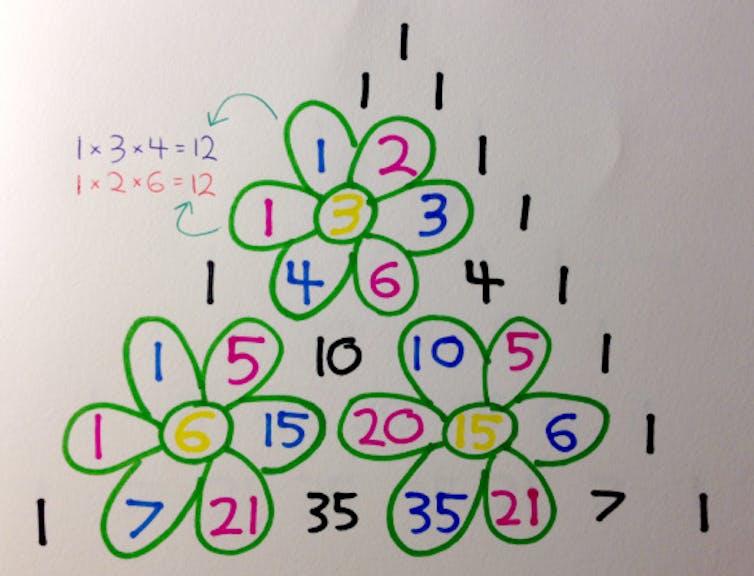
The 12 days of Pascal’s triangular Christmas

One of the most magical aspects of mathematics is the ability for complex and intricate structures to emerge from the simplest of rules. Few mathematical objects are simpler to create – and few weave such a variety of intricate patterns – as Pascal’s marvelous triangle.
by https://theconversation.com/the-12-days-of-pascals-triangular-christmas-21479 Also see A Triangle Calculator

Thursday, January 19, 2017

The Paperfuge: A 20-Cent Device That Could Transform Health Care

THE LOOSE ASSEMBLAGE of paper and string Manu Prakash pulls from his pocket doesn’t look like much. And in a way, it’s not—just 20 cents’ worth of materials you can buy at an art supply store. But in another way, the Stanford bioengineer’s tangle of stuff is a minor miracle. Prakash calls it a Paperfuge, and like the piece of lab equipment it’s named for, the centrifuge, it can spin biological samples at thousands of revolutions per minute. That’s a critical step in the diagnosis of infections like malaria and HIV. But unlike a centrifuge, the Paperfuge doesn’t need electricity, complicated machinery, expensive replacement parts, or even much money to operate.
by (https://www.wired.com/2017/01/paperfuge-20-cent-device-transform-health-care/)

...

Thursday, June 02, 2016

Loren Carpenter Experiment at SIGGRAPH ‘91

Loren Carpenter Experiment at SIGGRAPH '91 from Zachary Murray on Vimeo.

Loren Carpenter presents an experiment at SIGGRAPH 1991 by projecting a game of Pong. The game is controlled by paddles distributed to an audience, which spontaneously organizes itself to play the game.
by (https://vimeo.com/78043173)

Monday, April 04, 2016

Programming language for novel biological circuits

"It is literally a programming language for bacteria," says Christopher Voigt, an MIT professor of biological engineering. "You use a text-based language, just like you're programming a computer. Then you take that text and you compile it and it turns it into a DNA sequence that you put into the cell, and the circuit runs inside the cell."
by (https://www.sciencedaily.com/releases/2016/03/160331154001.htm)

Wednesday, November 26, 2014

Vortex

In short, it is fringe theory science-babble wrapped in pretty animation. The majority of those viewers will watch it, accept it and move on. And with 1.4 million views and climbing, the video has spread more misconceptions in a day than I or most other scientists could counter in a year. Pretty noise that overwhelms the signal.
by (https://briankoberlein.com/2014/03/15/signal-noise/)

Saturday, October 04, 2014

Save The Humans

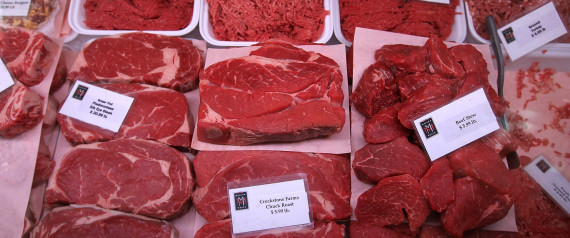
It takes around 15 pounds of grain to make one pound of beef - which can feed a couple people for a few hours. In comparison, 13 pounds of grain fed to humans directly can feed 13 people for most of the day. ... a long shower uses around 40 gallons of water. Whereas it takes 4,000 to 18,000 gallons of water to create a 1/3 lb hamburger. ... Let's put this in perspective: the good people of Philadelphia create roughly 1,000,000 tons of urine and feces per year. And one, only one, large pig farm will produce roughly 1,600,000 tons of urine and feces per year. ...
by (http://www.huffingtonpost.com/moby/moby-meat_b_5889850.html)

Friday, August 08, 2014

Self Portraits

William Utermohlen was diagnosed with Alzheimer’s disease. He created a heart-wrenching final series of self-portraits over a roughly 5-year period documenting the gradual decay of his mind due to this crippling illness
by (http://themetapicture.com/man-with-alzheimers-drew-self-portraits-for-5-years-until-he-could-barely-remember-his-own-face/)

Sunday, October 20, 2013

Is hydrogen the car fuel of the future?

Daimler, Honda, Toyota, General Motors and Hyundai among others are committed to putting hydrogen-fuelled fuel-cell cars on limited sale in Europe by 2015 and the recent partnership between leading fuel-cell proponents General Motors and Honda, as well as the similar two-year-old deal between Toyota and BMW shows that car makers, if not analysts and the press, are taking this zero-tail-pipe emissions technology seriously.
by (http://www.telegraph.co.uk/motoring/news/10372670/Is-hydrogen-the-car-fuel-of-the-future.html)

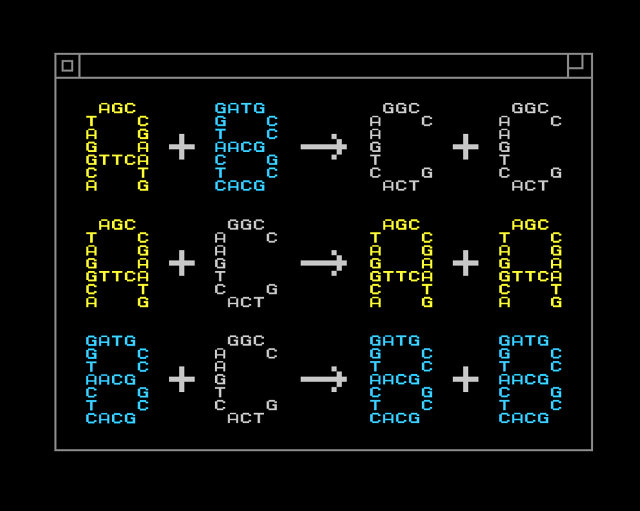
A New Programming Language That Can Shape Our DNA

Scientists have studied the behavior of complex biological molecules such as DNA for decades. Now they are moving to being able to control that behavior in test tubes and inside cells.
by (http://www.fastcoexist.com/3019370/futurist-forum/a-new-programming-language-that-can-shape-our-dna)

Sunday, October 13, 2013

Inspirations

When this animation project started to take their first steps I intended to bring life to a large and extensive still life, flying over it in a manner similar to that fantastic intro created for the opening credits of a French film called Delicatessen. But then I still had not found the motif, the main characters of the action. So I looked into that enormous and inexhaustible source of inspiration that is Escher and tried to imagine how it could be his workplace, what things would surround an artist like him, so deeply interested in science in general and mathematics in particular. This, though, from a completely imaginary, free and invented point of view. And here is the result of that process, accompanied by the beautiful song “Lost Song” composed by Ólafur Arnalds, an Icelandic musician. Hope you like. Cristobal Vila, February 2012, Saragossa, Spain.
by (http://www.etereaestudios.com/docs_html/inspirations_htm/intro.htm)

Thursday, August 29, 2013

Why Dentists Should Fear Snails

"My snail," Elizabeth learned, "possessed around 2,640 teeth ... The teeth point inward so as to give the snail a firm grasp on its food; with about 33 teeth per row and maybe 80 or so rows, they form a multitoothed ribbon called a radula."
by (http://www.npr.org/blogs/krulwich/2013/08/02/208236477/why-dentists-should-fear-snails)

Wednesday, August 28, 2013

When I think, you move

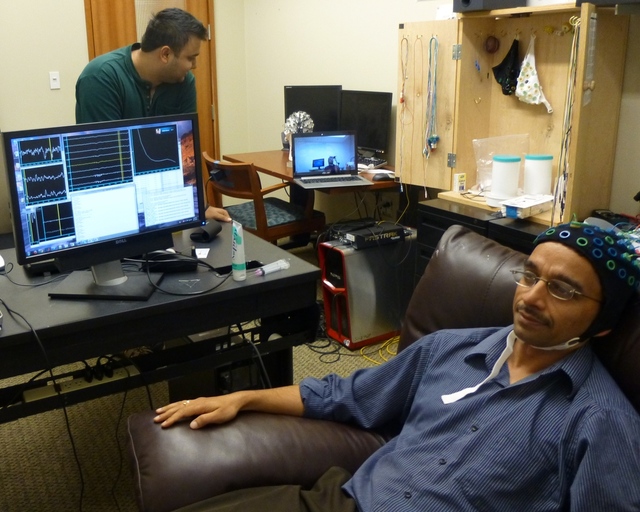
"It was both exciting and eerie to watch an imagined action from my brain get translated into actual action by another brain," Rao said.

by (http://www.theverge.com/2013/8/27/4664722/researchers-control-a-subjects-body-with-another-persons-brain)

Saturday, April 20, 2013

Earth 7 Billion Years From Now An Epic Story


by (http://www.cosmicspew.com/2012/01/earth-7-billion-years-from-now-epic.html?m=1)